
Even if we brush our teeth regularly every day, tartar buildup can occur in certain areas over time. These hard deposits, which are particularly common on the inner surfaces of the lower front teeth or near the gum line, cannot be removed through at-home oral care. In such cases, professional tartar removal may be necessary.
Well, How often should tartar be removed? Although it’s a common recommendation to have tartar removed every six months, this timeframe doesn’t apply to everyone. While tartar builds up more quickly in some people, the buildup may be more limited in others. Gum health, oral hygiene habits, and an individual’s current risk factors play a significant role in determining the need for cleaning.
For this reason, the most appropriate approach is to determine when a dental scaling should be performed based on the results of an oral and gum examination conducted by a dentist.
What Is Dental Calculus and How Does It Form?
Tartar forms when bacterial plaque that accumulates on tooth surfaces hardens over time due to minerals in saliva. Dental plaque, which initially appears as a soft layer, can mineralize and turn into tartar if it is not cleaned regularly and effectively.
Dental calculus is often more noticeable along the gum line, on the surfaces between the teeth, and in areas near the openings of the salivary glands.
In particular, the surfaces on the tongue side of the lower front teeth and the surfaces of the upper back teeth facing the cheek are areas where tartar buildup is common.
Once tartar has formed, it cannot be removed with a toothbrush or dental floss. To remove these hard deposits, a professional cleaning by a dentist is necessary.
Tartar buildup does more than just create an unsightly appearance. By facilitating the accumulation of bacterial plaque on its surface, it can contribute to the development or persistence of gum inflammation.
How Often Should Dental Calculus Be Removed?
There is no single time frame that everyone must follow for tartar removal.
People with healthy gums, who practice regular oral hygiene, and who do not have significant tartar buildup may not need professional cleanings at frequent intervals. In contrast, people who develop tartar quickly or who have gum disease may require closer monitoring and more frequent professional care.
Six-monthly dental checkups are a widely recognized practice in society. However, Having a dental checkup every six months is not the same as getting your teeth cleaned every six months.
During a dental examination, the dentist assesses tartar buildup, gum bleeding, periodontal pocket depths, and oral hygiene. Based on these findings, a determination is made as to whether a professional cleaning is necessary.
In patients who have undergone treatment for periodontitis in particular, shorter follow-up intervals—such as three to six months—may be recommended as part of periodontal maintenance therapy. However, these intervals are also tailored to the patient’s condition and risk factors.
Why Does Tartar Build Up Faster in Some People?
Even among two people with the same oral hygiene habits, the rate of tartar buildup may vary.
One of the reasons for this is the mineral content of saliva and the natural conditions inside the mouth. However, the alignment of the teeth, the presence of hard-to-clean areas, and the effectiveness of daily oral hygiene can also affect tartar buildup.
The main factors that can influence tartar buildup are as follows:
- Failure to clean teeth adequately and effectively,
- Failure to clean between the teeth regularly,
- The difficulty in reaching certain areas due to crooked teeth,
- The properties and mineral content of saliva,
- The use of cigarettes and other tobacco products,
- The presence of orthodontic appliances or restorations that are difficult to clean,
- A history of gum disease.
The presence of these factors does not mean that tartar will form at the same rate in every patient. However, they must be taken into account when assessing the need for professional cleaning and checkups.
What Happens If You Don't Have Your Tartar Removed?
If tartar buildup remains in the mouth for a long time, it can make it difficult to remove the bacterial plaque around it.
Plaque that accumulates along the gumline, in particular, can lead to the development of gingivitis, which is characterized by symptoms such as redness, swelling, and bleeding of the gums.
Gum inflammation can be controlled with proper oral hygiene and the necessary professional treatment. However, in susceptible individuals, periodontal disease can progress and lead to the loss of the tissues and bone that support the teeth.
There is an important distinction here: Dental calculus alone is not the cause of all gum diseases. Bacterial plaque, the individual’s immune response, and various risk factors all play a role in the development of the disease.
For this reason, while tartar removal is an important part of oral and gum health care, it does not replace regular at-home care.
How is Dental Stone Cleaning Done?
Professional dental scaling is the process of removing hardened deposits that have accumulated on tooth surfaces using appropriate dental instruments.
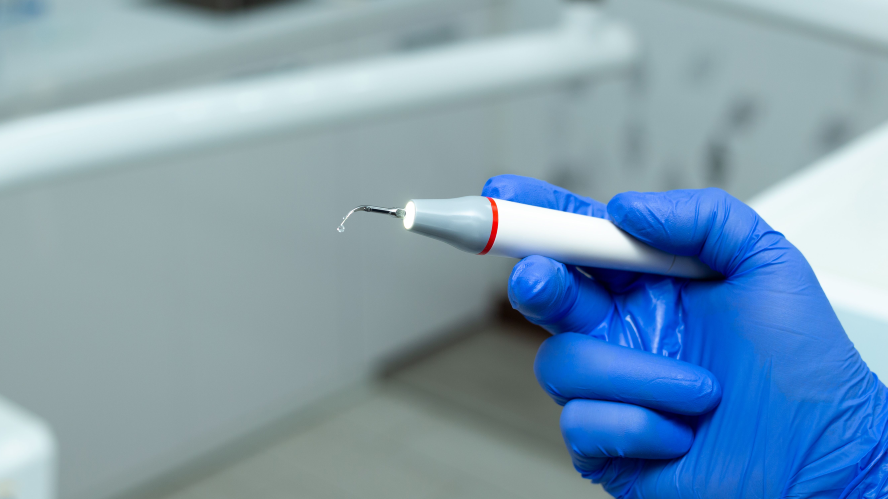
Ultrasonic devices or hand-held instruments may be used during cleaning. Ultrasonic devices remove tartar through vibration. The water used during the procedure helps the device function and cleans the area.
When necessary, polishing may be performed to remove stains and any remaining soft deposits from the tooth surfaces.
The duration of the procedure varies depending on the amount of tartar, the areas where it has accumulated, and the health of the gums.
For some patients with gum disease, simply removing tartar from the gums may not be sufficient. More extensive periodontal procedures—such as removing deposits beneath the gums and treating the root surfaces—may be necessary.
For this reason, not all professional dental cleanings should be considered the same.
Does Dental Stone Cleaning Damage Tooth Enamel?
One of the most common concerns about dental tartar removal is whether the tooth enamel is worn away during the procedure.
The purpose of professional dental scaling, performed with the appropriate equipment and the correct technique, is not to wear down tooth structure but to remove hard deposits that have adhered to the tooth surface.
Some patients may report that there are more gaps between their teeth after a cleaning or that the surfaces of their teeth feel different.
This may be related to the removal of tartar from areas that were previously filled with it or to existing gum recession becoming more noticeable. Tartar removal is not a procedure that removes healthy tooth structure and widens the spaces between teeth.
However, temporary sensitivity may occur after the procedure, particularly in patients with receding gums or exposed root surfaces.
Is There Sensitivity After a Dental Calculus Cleaning?
After tartar removal, some people may experience temporary sensitivity to cold foods and beverages.
This condition may be more pronounced in patients with heavy tartar buildup, receding gums, or exposed root surfaces.
Sensitivity often decreases over time. However, severe, prolonged, or progressively worsening sensitivity should be evaluated by a dentist.
A dentist may recommend products to relieve sensitivity or provide personalized care recommendations when necessary.
Does Tartar Reform After Tartar Removal?
Tartar removal removes existing buildup but does not completely prevent new tartar from forming in the future.
Since bacterial plaque continues to form in the mouth, it is important to maintain a daily oral care routine. It is especially important to effectively clean the areas near the gum line and between the teeth.
Habits that can help reduce tartar buildup include brushing your teeth twice a day with fluoride toothpaste, regularly cleaning between your teeth, and adhering to the checkup schedule recommended by your dentist.
For some people, special toothpastes designed to reduce tartar buildup can be helpful. However, these products do not remove existing tartar and are not a substitute for professional cleaning.
Are Dental Calculus Removal and Teeth Whitening the Same Procedure?
Although tartar removal and teeth whitening are sometimes confused with one another, they are procedures performed for different purposes.
The goal of dental scaling is to remove hard deposits from the tooth surfaces and, when necessary, surface stains.
Teeth whitening, on the other hand, is a different treatment used to lighten the natural color of the teeth.
After a professional cleaning, especially when surface stains caused by tea, coffee, or tobacco are removed, teeth may appear cleaner and brighter. However, this does not mean that the tooth’s natural color has been whitened.
How Can You Tell If You Need a Dental Calculus Cleaning?
In some people, tartar buildup may be noticeable when looking in the mirror. In particular, hard, yellowish or brownish deposits near the gum line may indicate the presence of tartar.
However, not all tartar is visible to the naked eye. Deposits located beneath the gums can only be detected during a clinical examination.
Symptoms that may be related to tartar or gum problems include bleeding gums, bad breath, and redness and swelling of the gums.
The presence of these symptoms does not always mean that tartar is present, just as the absence of any symptoms does not mean that a professional evaluation is unnecessary.
For this reason, the decision on whether tartar removal is necessary should not be based solely on the appearance of the teeth.