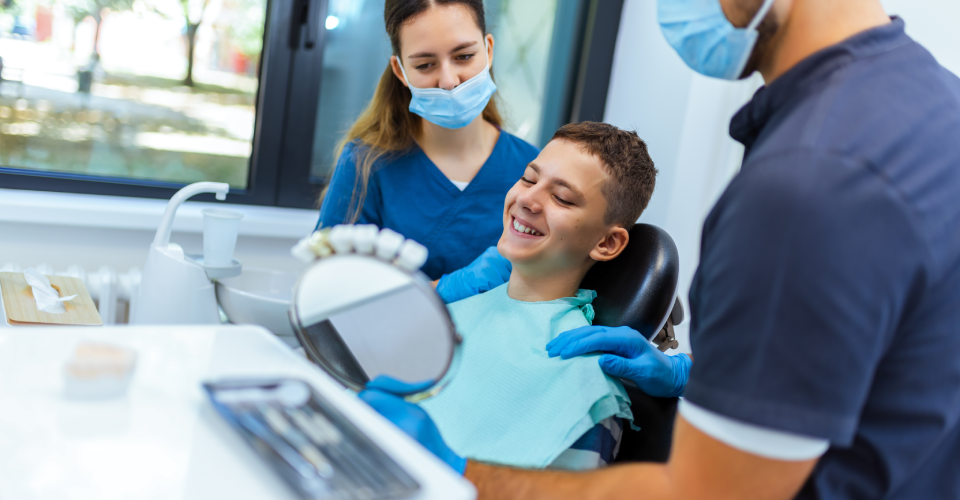
Department of Pedodontics is a branch of dentistry specific to children. It aims to establish oral and dental health at an early age by dealing with the protection, treatment and development of oral and dental health in children aged 0-15. Treatments in the pedodontics clinic are carried out by specialist physicians who have received special training in communicating with children, relieving their concerns about dental health and ensuring comfort during the treatment process, and who know the complex development processes of children's teeth and oral structures.
On average, babies are 6-10. The first milk teeth begin to appear between months. The eruption order is lower front incisors, upper front incisors, upper lateral incisors, lower lateral incisors, upper 1st primary molars, lower 1st primary molars, upper canines, lower canines, lower 2nd primary molars and upper 2nd primary molars. Situations such as diarrhea/constipation, vomiting, nausea, cough, and mild fever observed in children during the teething period develop completely coincidentally rather than being related to teething. However, since there is redness, swelling, itching and pain in the gums in the eruption area, the baby becomes moody, loses appetite and insomnia occurs. For these reasons, a general loss of resistance may cause the baby to be easily affected by infections. These complaints disappear immediately after tooth eruption. If the child is in great distress, applying a local pain-relieving pomade 3-4 times a day will temporarily relieve the child. Additionally, mouth scratchers can be used to relieve itching by rubbing the gums. Liquid mouth scratchers, which can be used after being frozen in the freezer, also provide relief from itching due to the cold effect. If there is fever, antipyretic drugs other than aspirin can be given.
Children should be taken to the dentist before the age of 1 after their first teeth erupt. During this early examination, pediatric dentists give information to the parents about the baby's oral and dental hygiene, bottle-pacifier use, and nutritional habits, and explain ways to protect against tooth decay. It examines whether there are habits that may affect the development of the jaw and face, such as thumb sucking and mouth breathing, and ensures that the necessary measures are taken to eliminate them.
After all the baby teeth are completed, children can start brushing their teeth. Since this age range is a period in which the child's manual dexterity develops, it can be ensured that they can hold the brush properly. For young children in the preschool period, the aim should be to give the child the habit of brushing teeth rather than teaching them how to brush their teeth. Therefore, it does not matter how he brushes, just rubbing the brush on his teeth will be enough.
Since there is a risk of swallowing, fluoride-free toothpaste should be used until the child acquires the ability to rinse his mouth and spit. However, since fluoride-free toothpastes do not have the ability to prevent tooth decay, it may be necessary to use fluoride toothpaste in children with a high risk of tooth decay. In this case, the paste should be the size of a grain of rice. After the age of 3, if the child can rinse his mouth and spit, fluoride toothpaste can be used, but care should be taken that it does not exceed the size of a pea. Dental floss can be used after the eruption of 6-year-old teeth. However, you need to get help from your dentist on how to use it.
Not only sugar, but all carbohydrate foods that are soft and can easily stick to the teeth are cavities-causing. However, the frequency of intake has a greater effect on the formation of caries than the amount of carbohydrate foods consumed. Therefore, continuous intake of carbohydrate-type foods in the form of snacks between main meals increases the risk of caries. However, for this reason, instead of forbidding the child from eating chocolate, cake, cake, pastries and candy, it would be a better approach to teach the child that he should brush his teeth after eating such foods, and if brushing is not possible, he should rinse his mouth with water or drink a glass of water after eating to clean the food residues stuck on his teeth.
It is recommended to use a mouthguard to prevent the child from biting his tongue and cheek and teeth from hitting each other during sports, and to absorb the force of the impact on the teeth.
If the child's tooth is broken in any way, the dentist should be visited as soon as possible. Having the broken piece at hand may be beneficial for treatment because, depending on the shape and size of the fracture, the dentist may choose to replace the broken piece. If the tooth is displaced as a result of an impact, it is necessary to preserve the tooth in the right conditions and deliver it to the dentist within 1 hour at the latest. To do this, the tooth is washed under very slowly running water without touching the root, then preserved in milk or serum and taken to the dentist. If there is no milk or serum, saliva is also a suitable medium to store the tooth. For this purpose, the tooth can be kept either in the child's mouth, in the hole between the cheek and the teeth, or in the glass where the child collects his saliva. In any case, going to the dentist as soon as possible is important for the success of the treatment.