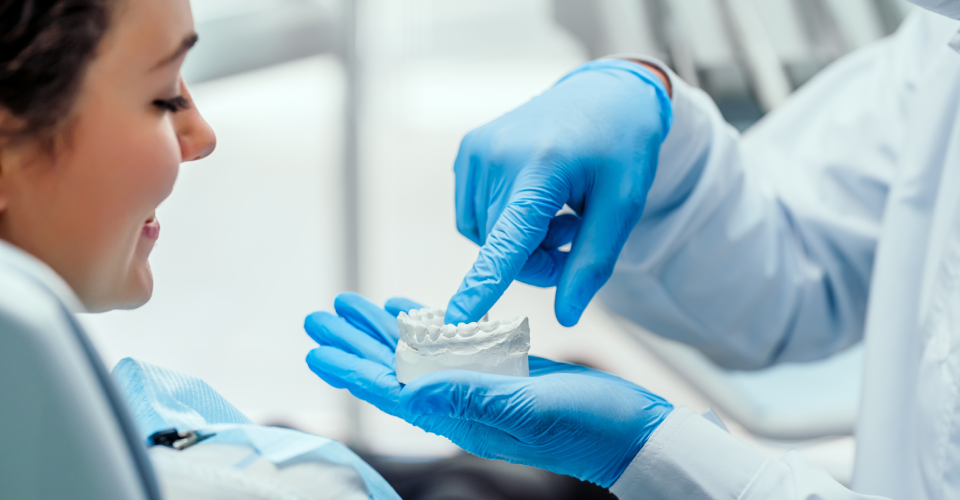
Including diagnosis and treatment planning of patients with missing or lost teeth and/or maxillofacial tissues; It is the specialty of dentistry concerned with the use of biocompatible materials and the maintenance of oral function, comfort, appearance and health. It covers areas such as removable prosthesis, fixed prosthesis, implantology, TMJ disorders and maxillofacial prosthesis.
They are prostheses that replace teeth in a fully or partially edentulous dental arch. They can be put on and removed by the patient. The retention of the prosthesis is provided by teeth, oral tissues, implants or a combination of these.
They are prostheses that replace teeth in a partially edentulous dental arch. It is especially applied in case of periodontal weak teeth or long toothless areas. The retention of the prosthesis is provided by clasps and precision holders.
They are removable prostheses that replace all teeth and associated tissues of the upper and lower jaws. The retention of the prosthesis is provided by the surrounding tissues.
These are prostheses that cover a prepared tooth, root or implant with the help of cement. Fixed prostheses that cannot be removed by the patient are made of metal or porcelain.
They are fixed prostheses in which a single tooth with tissue loss is covered with metal, porcelain or combinations.
They are fixed prostheses that are cemented to dental tissues, especially enamel. The supported teeth are acidified to assist with the cement. It is generally used for front tooth loss.
These are fixed prostheses used for the loss of one or more teeth. A bridge supported by teeth adjacent to the toothless area is created to replace the missing teeth.
These are treatments in which a thin layer of porcelain is applied to the surface of teeth with aesthetic problems in the desired color, size and shape.
These are crowns produced to be placed on a primary structure. Primary structure; Another crown may be a bar or structure that provides appropriate rigidity. It is applied in the presence of crooked or extruded teeth that will cause compatibility problems with the prosthesis.
These are fixed restorations used on teeth whose tissue loss is too great to be filled and which do not require a crown.
These are prostheses whose retention or support is provided by implants. They can be planned as mobile or fixed.
They are prostheses that repair and/or replace missing stomatognathic and craniofacial structures with regularly or electively removable or non-removable prostheses.
It is a disorder in the functions of the TMJ due to disorders in the joint structure or tissues around the joint. TMJ disorder affects the entire stomatognathic system, which consists of oral tissues, head and neck muscles, and ligaments. Discomfort; It is characterized by pain and tenderness in the muscle or joint itself, limitation of jaw movements and noise.
TMJ disorders are treated with multidisciplinary studies.
Zircon; It is a type of ceramic used in the restoration of broken, damaged or decayed teeth. Since zircon mimics the color and transparency of natural tooth enamel very well, its compatibility with natural teeth is very high. Thus, aesthetic and durable prostheses that provide the perfect smile are applied.
All on four is a treatment procedure that fixes the prosthesis with the use of implants in edentulous patients. By placing four implants at certain angles, the prosthesis is applied and comfort is provided to the patient. This technique increases the use of bone in atrophic jaws, reduces the need for regenerative treatment, and minimizes complications and costs.