
There are various treatment options available for people who are dissatisfied with the color of their teeth but prefer to whiten them at home rather than at a dental clinic. One of these options is at-home teeth whitening performed under the supervision of a dentist.
Well, What is at-home teeth whitening? At-home teeth whitening is a treatment method in which whitening products suitable for the patient—and trays that are typically custom-made—are used following an evaluation by a dentist. Although the procedure is performed at home, the treatment is planned and monitored by the dentist.
This method differs from whitening products sold in stores or online that people use on their own initiative. The ingredients of the product to be used, the application time, and the treatment plan are determined based on the patient’s tooth structure and needs.
How to Do Home Teeth Whitening?
At-home teeth whitening is a process that begins with a dental examination, not with the patient simply choosing a product on their own.
First, the current color of the teeth, gum health, and any dental restorations are evaluated. If there are conditions such as tooth decay, gum disease, or noticeable sensitivity, these may need to be addressed before whitening.
Once it is determined that the patient is a suitable candidate for at-home teeth whitening, custom trays can be prepared using dental impressions or digital scans, depending on the system to be used.
These trays help ensure that the whitening product comes into controlled contact with the tooth surfaces.
The dentist explains to the patient how much of the product to use, how to insert the tray, and how long the treatment will last. The patient then performs the procedure at home according to the prescribed schedule.
During treatment, any discoloration of the teeth and possible sensitivity are monitored.
How Do You Use At-Home Teeth Whitening Trays?
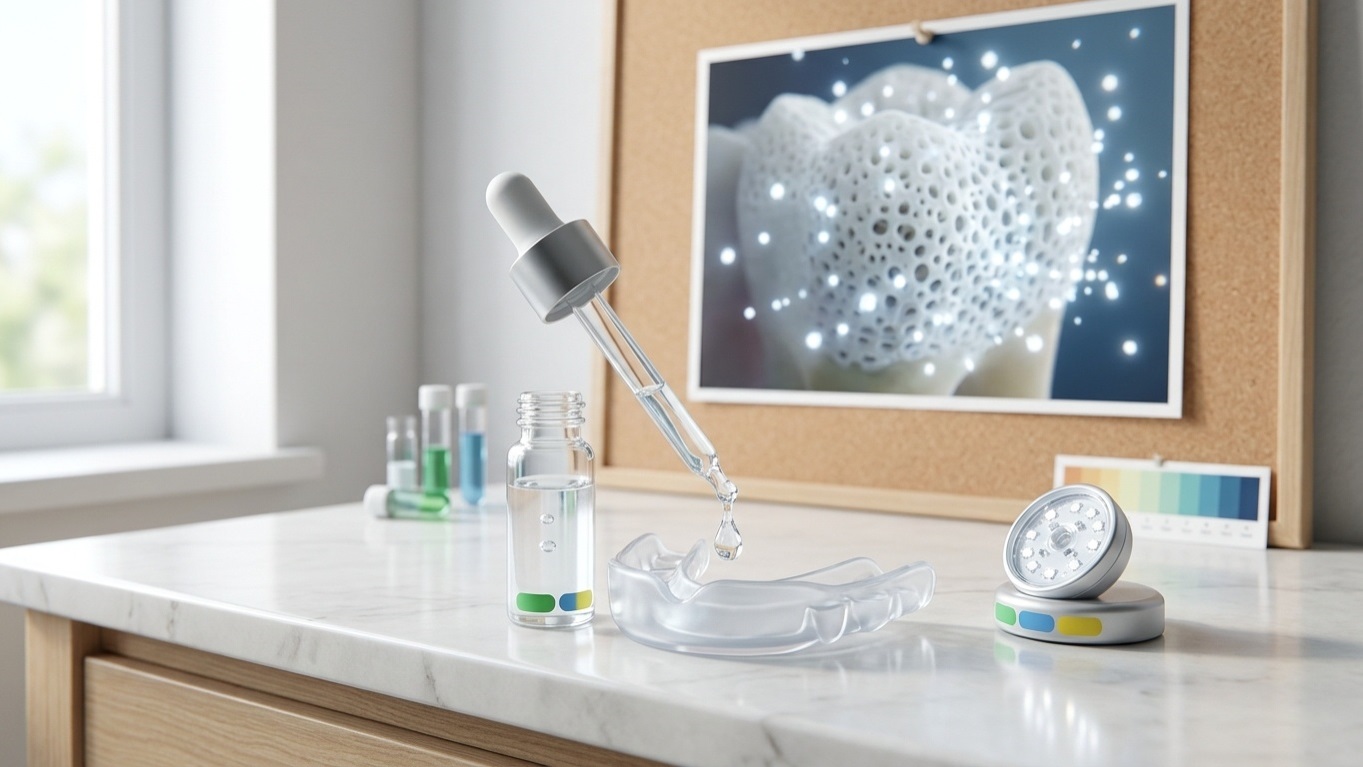
The trays used in at-home teeth whitening are clear aligners that are placed over the teeth. These custom-made trays are designed to ensure that the whitening product remains in the appropriate areas.
During the procedure, the amount of whitening gel recommended by the dentist is applied to the relevant areas of the tray. The tray is then placed over the teeth and kept in the mouth for the specified duration.
The most important point here is not to use more of the product than necessary. Applying too much gel may not result in faster whitening. On the contrary, it may cause the product to spread onto your gums and lead to irritation.
After the procedure is complete, the tray is removed, and the mouth and tray are cleaned as recommended by the dentist.
How to store and clean the plates may also vary depending on the material used. Therefore, it is important for the patient to follow the instructions provided.
How Many Days Does At-Home Teeth Whitening Take?
The duration of at-home teeth whitening treatment varies depending on the ingredients and concentration of the whitening product used, as well as the current shade of the teeth.
While treatment in some protocols lasts about one to two weeks, some patients may require a longer course of treatment.
The duration of daily use for whitening products also varies by system. While some products are designed for shorter-term use, others can be used for longer periods.
For this reason, there is no single treatment duration that applies to everyone for at-home teeth whitening.
Wearing the aligner for longer than the dentist recommends or extending the treatment on your own does not guarantee better results. In particular, it can lead to unwanted side effects such as sensitivity and gum irritation.
When Does At-Home Teeth Whitening Start to Work?
In at-home teeth whitening treatments, color changes typically occur gradually.
While some people may notice a difference in tooth color after the first few treatments, it may take longer for the change to become noticeable in some patients.
The results will depend on the initial color of the teeth, the cause of the discoloration, and the whitening system used.
Certain types of discoloration, particularly those dominated by yellow tones, may respond better to whitening. In contrast, the response to treatment may be more limited for some internally caused discoloration that occurs during tooth development.
For this reason, it is important to assess the patient’s expectations before beginning in-office teeth whitening and to explain that the results may vary from person to person.
How Many Shades Does At-Home Teeth Whitening Lighten?
At-home teeth whitening can lighten the color of your teeth by a few shades. However, the same number of shades of lightening is not achieved in every patient.
The color scales used to assess tooth color are influenced by the initial shade and the individual’s response to whitening.
For this reason, it is not accurate to say that at-home hair lightening will definitely result in a specific number of shades lighter.
In addition, the appearance of teeth after whitening is not solely determined by the change in the color scale. The structure of tooth enamel, the natural color of dentin, and the way light reflects off tooth tissues also affect how teeth look.
The goal in evaluating the results of teeth whitening is to achieve a color change that is consistent with the patient’s natural tooth structure.
What Is the Difference Between At-Home and In-Office Teeth Whitening?
The two main methods used in teeth whitening treatments are at-home and in-office whitening.
In-office teeth whitening is performed by a dentist in a clinical setting. This method typically involves the use of whitening products with higher concentrations, and color changes can be achieved in a short period of time.
With at-home teeth whitening, the patient uses the products recommended by the dentist at home according to a set schedule. The color change typically occurs over a period of days or weeks.
Both methods have their advantages and limitations.
At-home teeth whitening allows the treatment to be continued as part of daily life, but it requires the patient to follow the treatment instructions regularly.
With in-office teeth whitening, however, the procedure is performed directly in a clinical setting, and the process is supervised by a dentist.
When performed according to proper protocols, both methods can produce effective results. It cannot be said that one method will provide greater whitening than the other for every patient.
The choice of method depends on the patient’s oral health, the characteristics of the discoloration, and the patient’s expectations.
Is At-Home Teeth Whitening Safe?
At-home teeth whitening, when performed under the supervision of a dentist, using appropriate products, and adhering to the recommended treatment duration, is generally considered a safe method for suitable patients.
However, as with any cosmetic dental procedure, some side effects may occur.
One of the most common complaints is temporary tooth sensitivity. This sensitivity may be felt more distinctly, especially when consuming cold foods and beverages.
If the whitening product comes into contact with the gums, it may cause temporary irritation.
In such cases, it is important for the patient to consult their dentist rather than continuing the treatment on their own. If the dentist deems it necessary, they may adjust the duration of use, the frequency of application, or the treatment protocol.
Does At-Home Teeth Whitening Damage Tooth Enamel?
One of the most common questions about at-home teeth whitening is whether the procedure wears down tooth enamel.
Teeth-whitening treatments that are properly planned and administered by a dentist are generally considered safe. However, this does not mean that all whitening products can be used without restriction or supervision.
In particular, using products with high concentrations for longer than necessary or repeating applications too frequently can lead to unwanted effects.
In addition, if there are any existing cavities, cracks, or sensitivity in the teeth, these conditions must be evaluated before whitening.
The most important factor in protecting tooth enamel is ensuring that the teeth-whitening treatment is planned in a way that is appropriate for the individual’s oral health.
Is At-Home Teeth Whitening Permanent?
The color change achieved through at-home teeth whitening may fade over time.
The natural aging process of teeth, tea and coffee consumption, tobacco use, and oral hygiene habits can contribute to the development of discoloration.
In some patients, the whitening effect lasts for a long time, while in others, a change in color may occur sooner.
For this reason, it is not possible to give a definitive timeframe for how long at-home teeth whitening results will last for everyone.
Regular oral care and limiting habits that cause staining can help maintain the results achieved.
If necessary, additional whitening treatments may be scheduled based on the dentist’s assessment. However, it is important that the patient not decide on their own when to repeat the treatment.
Do At-Home Teeth Whitening Kits and Veneers Whiten Teeth?
At-home teeth whitening is designed to lighten the color of natural tooth structure. However, composite fillings, porcelain veneers, and zirconia restorations do not whiten in the same way as natural teeth.
Especially in people with fillings or crowns on their front teeth, a color difference may develop between their natural teeth and the restorations after teeth whitening.
For this reason, existing restorations must be evaluated before whitening.
In some patients, replacing restorations may be considered after teeth whitening to match the new tooth color. However, this procedure is not necessary for every patient.
The treatment plan is determined based on the current condition of the teeth and the patient's aesthetic expectations.
Are At-Home Teeth Whitening Products the Same as Professional At-Home Whitening?
When it comes to at-home teeth whitening, whitening strips, gels, or other products purchased online may also come to mind.
However, professional at-home teeth whitening performed under a dentist’s supervision should not be treated the same as products used at a person’s own discretion.
In professional practice, oral and dental health is assessed first. Then, the appropriate product, treatment duration, and follow-up plan are determined.
In the case of products used without proper guidance, the individual may choose a method that is not suitable for their current oral health or may use the product incorrectly.
In particular, the careless use of high-concentration whitening products can lead to problems such as gum irritation and sensitivity.
For this reason, it is important for people who want to whiten their teeth at home to consult a dentist first.
Who Should Not Use At-Home Teeth Whitening?
At-home teeth whitening may not be suitable for every patient.
For individuals with active tooth decay, untreated gum disease, noticeable tooth sensitivity, or cracks in their teeth, the existing problems must first be evaluated.
During pregnancy and breastfeeding, however, it is generally recommended to postpone cosmetic teeth-whitening procedures because there is insufficient safety data available.
The need for teeth whitening in children and adolescents should be evaluated on a case-by-case basis, taking into account their age and dental development.
In addition, for patients with noticeable intrinsic discoloration of their teeth or numerous restorations in the anterior region, different aesthetic treatment options may be more appropriate.
For this reason, the decision to undergo at-home teeth whitening should not be based solely on the color of your teeth.
What Should You Keep in Mind After At-Home Teeth Whitening?
While undergoing an at-home teeth-whitening treatment, it is important to follow the treatment schedule prescribed by your dentist.
Do not use more whitening gel than recommended, and do not leave the trays in for longer than the specified time.
If you experience sensitivity or gum irritation during treatment, you should inform your dentist.
After teeth whitening, regular brushing, cleaning between your teeth, and maintaining good oral hygiene can help preserve the results.
Factors such as tea, coffee, and tobacco products, which can contribute to staining, may cause tooth discoloration to reappear over time.
However, it cannot be said that everyone must follow a strict diet after teeth whitening. Dietary recommendations should be tailored to the product used and the patient’s condition.
At-Home Teeth Whitening at Istanbul Galata University Dental Hospital
At-home teeth whitening may seem like a simple cosmetic procedure because it is performed at home. However, to ensure safe and effective results, it is important to assess the current condition of the teeth and determine the appropriate treatment protocol.
At the Istanbul Galata University Dental Hospital, requests for teeth whitening are evaluated based on the patient’s oral and dental health, the characteristics of the existing discoloration, and their aesthetic expectations. For suitable patients, at-home or in-office whitening options may be planned as part of restorative dental treatment.
To find out if at-home teeth whitening is right for you and to learn about the available methods, you can schedule an appointment at our clinic.